

Nash: push or fold
Push or fold ranges at the Nash equilibrium, in heads-up or at a table of 3 to 6 players.
Titan › Nash: when everyone can only go all-in or fold, the hands to play at the Nash equilibrium. At the top, Players: from 2 to 6.
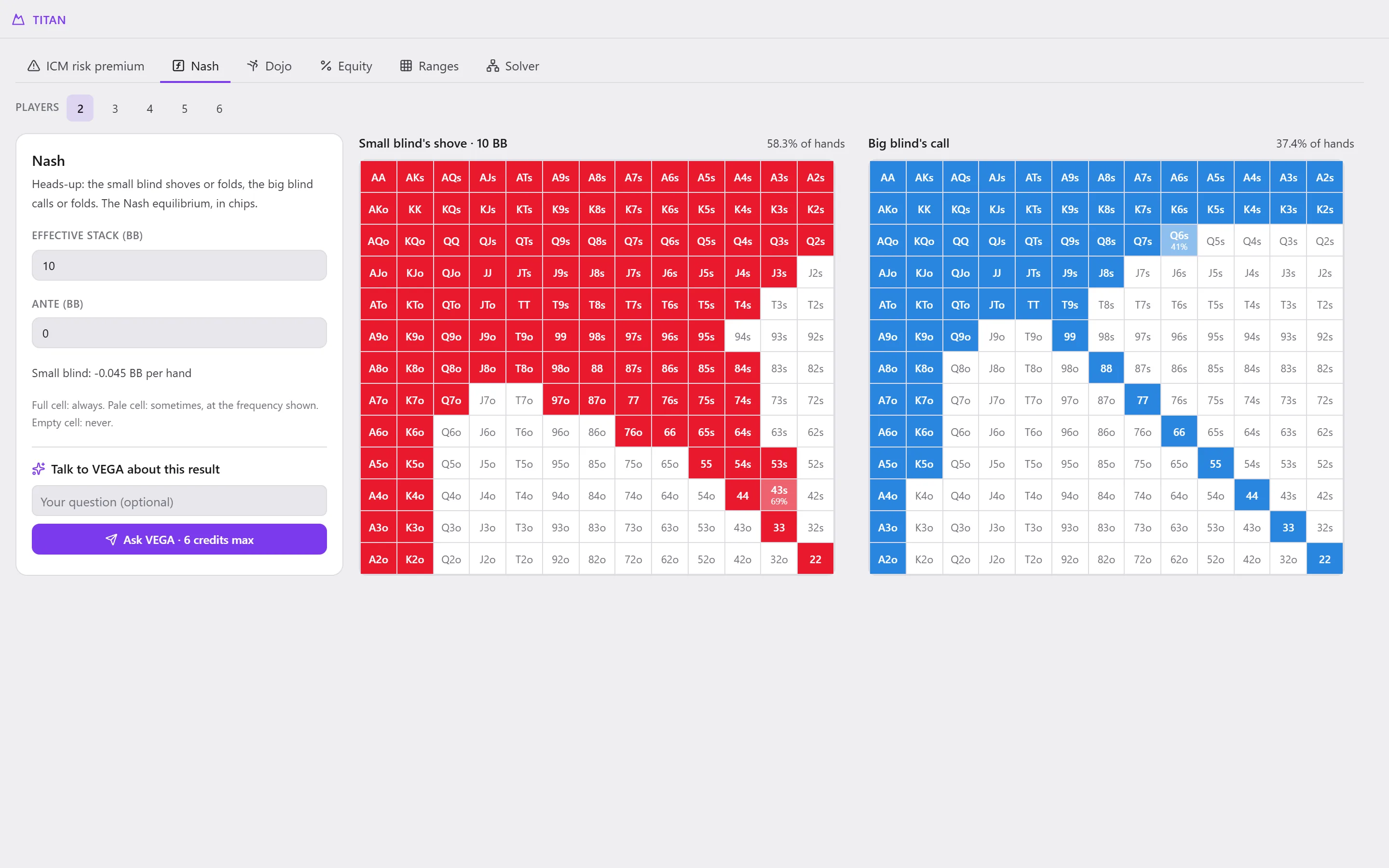
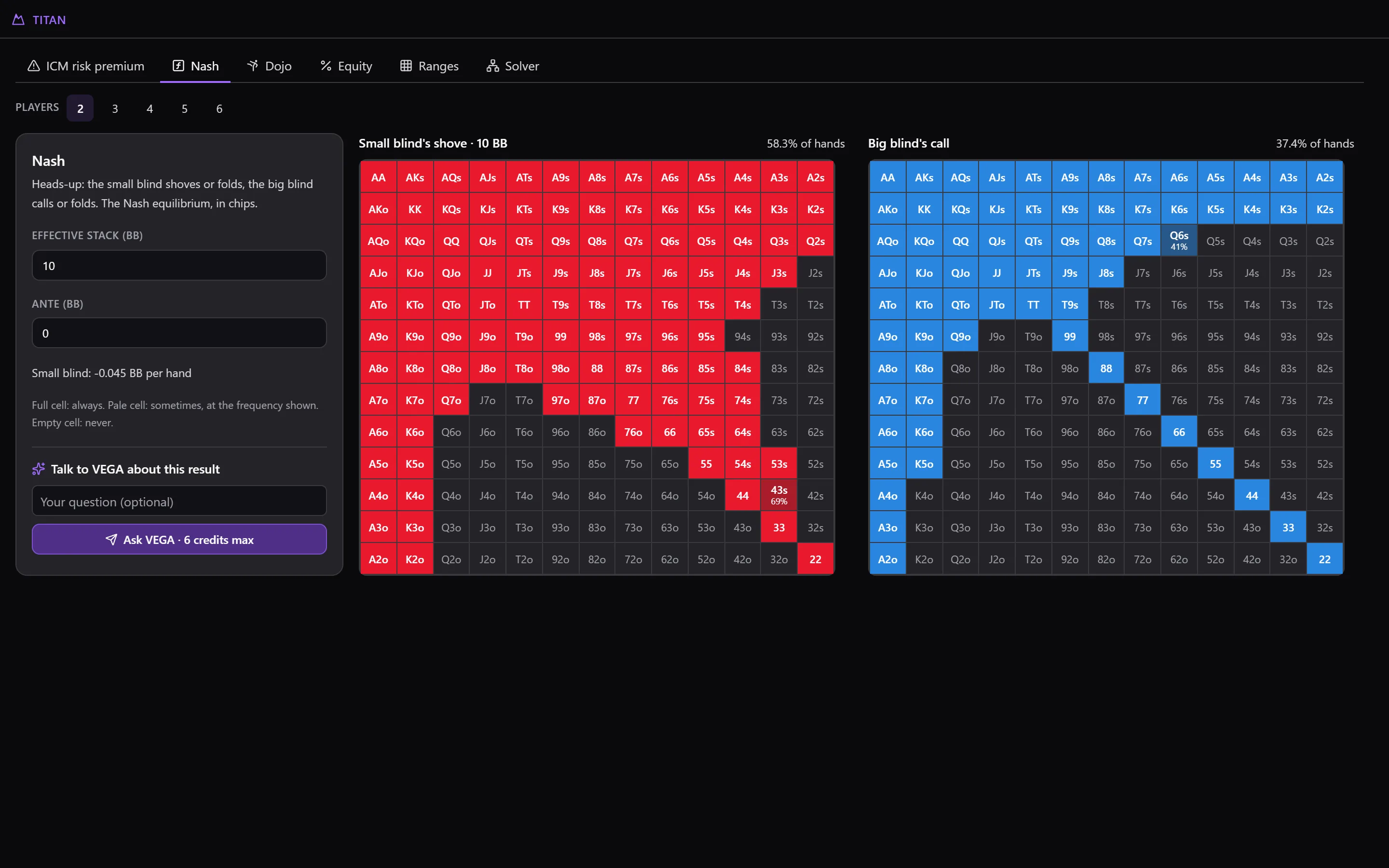
In heads-up
The small blind goes all-in or folds, the big blind calls or folds. Enter the Effective stack (BB) (from 1 to 1,000) and the Ante (BB): the two grids are worked out straight away.
- Small blind's shove and Big blind's call: the 169 hands, with the share of hands played.
- Full cell: always. Pale cell: sometimes, at the frequency shown. Empty cell: never.
- Under the settings: what the small blind wins per hand, in BB.
At a table (3 to 6 players)
Each in turn goes all-in or folds. The calculation is done on your computer.
- Enter each seat's stack (in BB) and the Ante.
- Choose the calculation: In chips, or at ICM with the Payouts.
- Compute. The progress is displayed (iterations, gap to the equilibrium); Stop interrupts it.
The result gives, for each seat, what it wins and its decisions: Nobody all-in, Against …'s all-in, Against the all-ins of … and …, each with the share of hands where it happens and the share of hands played. Click a decision to see its hands on the grid.
- At most 3 players in an all-in pot: the next ones fold.
- At ICM, the ICM is that of the stacks after this hand: the next hands are not played.
- Borderline hands are worth almost the same played or folded: their percentage can change a lot from one longer calculation to another, without changing the expected result.
On Free, Nash is open in heads-up; tables of 3 or more players are reserved for paid plans.
To train on these decisions: the Dojo.